
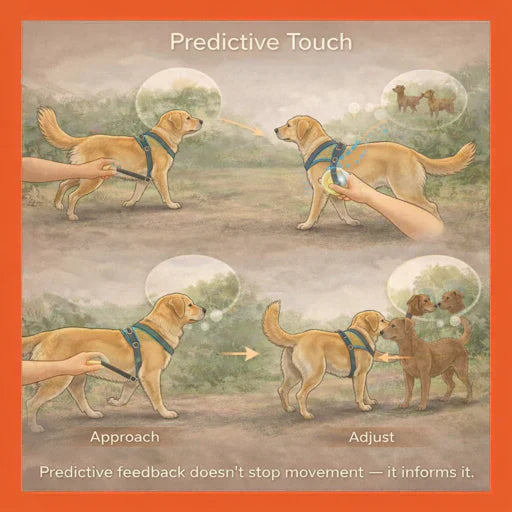
Predictive Touch: How the S-K9 ChestCollar Works Differently
Quick summary
The S-K9 works by making a dog’s first movement readable — not by blocking, correcting, or overriding it.
Most lead tools respond after pulling has already escalated.
The S-K9 ChestCollar is designed to intervene earlier — at the moment movement begins, not once conflict has formed.
Instead of meeting an initial surge with pain, restriction, or redirection, the S-K9 introduces a soft, predictive chest contact as the body starts to move forward. This contact arrives early enough to be noticed, but gently enough to avoid triggering resistance.
Nothing is stopped.
Nothing is forced.

The dog still feels the urge to move — but now also feels a subtle change in their body that invites awareness rather than opposition. For many dogs, this allows the nervous system to stay regulated and keeps thinking available.
If the dog re-balances or adjusts on their own, the moment resolves naturally. No escalation is required.
If movement continues, the S-K9 can follow through with a secondary grounding contact at the scruff. This is not a correction. It is a familiar, calming signal rooted in canine experience — one that many dogs recognise without needing to push against it.

Together, these two contacts aim to preserve the natural learning loop rather than interrupt it.
At no point does the dog need to fight the tool, lean into resistance, or comply to escape pressure. Because conflict is minimised, the body stays calmer, attention remains available, and awareness can return to what originally triggered the movement.
Over time, many dogs begin regulating the impulse earlier — before pulling fully develops. Not by avoiding pressure, but by completing the learning process in real time.
Key Takeaways
- The S-K9 does not interrupt first movement
- Early chest contact invites awareness, not resistance
- Scruff contact supports grounding without correction
- Learning continues without conflict or force
FAQs
Does the S-K9 stop dogs from moving forward?
No. It provides information, not restraint.
Why is early feedback important?
Because sensation arrives before escalation, allowing regulation to stay online.
Is predictive touch the same as correction?
No. It informs movement rather than punishing or blocking it.