
Self-Regulation: How Dogs Learn Naturally Off Lead
Quick summary
Off lead, dogs learn because the learning loop stays intact — movement, feeling, and choice unfold without interruption.
When dogs are off lead, learning tends to follow its natural course.
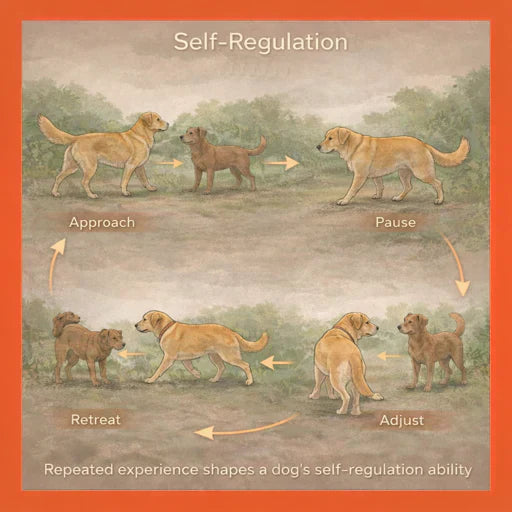
Movement begins freely. The dog approaches, pauses, speeds up, slows down, or changes direction based on what they encounter. Only after this movement does conscious processing have space to engage. The body feels what the movement creates, and regulation can follow.
This is why off-lead learning looks so fluid.
A dog notices what triggered the movement — another dog, a sound, a smell, a change in terrain. They feel the effect of getting closer or further away. From there, they adjust. Sometimes they continue. Sometimes they pause. Sometimes they disengage entirely.
Nothing forces a shortcut.
In this state, learning follows a simple sequence:
cause → feeling → choice
Because nothing interrupts the loop, the dog can integrate the experience instead of reacting against it. The nervous system learns what is manageable through direct feedback, not instruction.
This is also where self-regulation develops.
Self-regulation is the ability to settle one’s own nervous system after arousal. Off lead, dogs practise this constantly. They approach, retreat, circle, stop, sniff, or disengage — all without being restrained, redirected, or corrected. Each interaction teaches the body how much intensity it can handle and how to return to balance.
Crucially, self-regulation cannot be installed through commands or training techniques. It emerges through repeated, uninterrupted experiences where the dog is allowed to feel the full arc of interaction.
This is why off-lead dogs often appear calmer, more adaptable, and more socially fluent. They are not better trained — they are better regulated.
Learning hasn’t been added. It has been allowed.
Key Takeaways
- Off-lead movement preserves the natural learning loop
- Dogs learn by feeling the consequences of their own movement
- Self-regulation develops through uninterrupted experience
- Calm emerges from integration, not control
FAQs
Is off-lead learning always safe?
Safety depends on context, environment, and the dog’s history.
Why do dogs seem calmer off lead?
Because regulation follows experience instead of being interrupted.
Can self-regulation be trained on lead?
It can be supported, but it develops most naturally without restraint.