
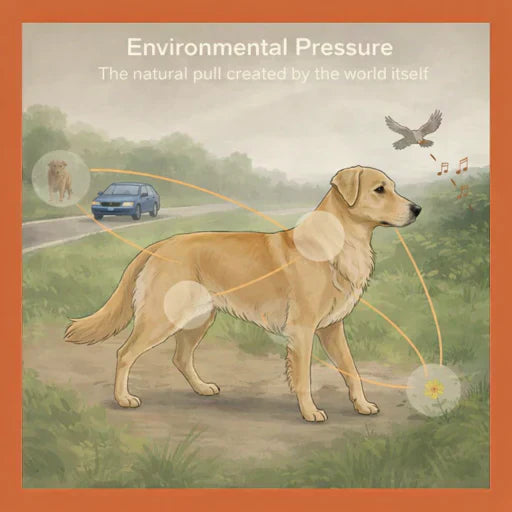
Environmental pressure in dog walking is the effect the surroundings have on the dog. Movement, scent, sound, novelty, proximity, and change can shape behaviour before the lead tightens or the handler acts.
Environmental pressure in dog walking is the effect the surroundings have on the dog during the walk. It comes from movement, scent, sound, novelty, proximity, and change: everything the dog processes while moving through the world. It can organise behaviour before the lead tightens and before the handler does anything at all.
This matters because the environment is never neutral.
A dog is not walking through empty space. It is moving through a living field of information, pressure, attraction, and change.
The environment is not just where the walk happens.
It is one of the forces shaping the walk.
What environmental pressure is
Environmental pressure is pressure created by the surroundings.
It does not come from the lead itself or from direct handler input. It comes from what the dog sees, hears, smells, anticipates, and moves through. Other dogs, passing people, traffic, narrow paths, open spaces, fast motion, strong smells, and unpredictable activity can all shape the dog before the handler does anything at all.
The environment is not just the setting of the walk.
It is part of the walk.
Why dogs are drawn to movement and stimuli
Dogs are often drawn to movement and stimuli because the environment contains things that naturally pull attention outward.
Motion, scent, sound, access, novelty, and sudden change can all become meaningful immediately. A bird lifting off, another dog appearing, a person moving quickly, activity ahead on the path, or a smell carried on the wind may be enough to redirect attention at once.
The dog is not necessarily choosing to ignore the handler.
Very often, the environment has simply become more compelling in that moment.
Why movement matters so much
Movement is one of the strongest triggers in dog walking.
A still object may be noticed. A moving object is more likely to pull orientation, focus, and intent. Dogs are highly responsive to change, especially when that change is fast, directional, unpredictable, or biologically relevant.
That is why movement can act like a magnet during walks.
The dog sees something shift and attention moves with it.
Why stimuli build outward focus
Stimuli do not need to be dramatic to affect behaviour.
A smell on the ground, a sound in the distance, a person approaching, a dog across the road, or activity further ahead may be enough to pull the dog outward. When several things happen together, that outward draw can build quickly.
The dog begins orienting away from the handler and more toward the environment. Scanning, speeding up, fixation, bouncing, hesitation, or pulling may follow and as that outward draw builds, so does what is arousal in dogs during walks.
Behaviour often reflects what the environment is asking of the dog.
Why attraction often comes before pulling
Attraction is often the first visible stage and understanding why dogs pull on the lead starts with recognising everything that happens before the tension appears
The dog notices something, becomes interested, and begins to move toward it mentally or physically. If that movement continues, lead tension may develop. Once tension appears, the behavioural picture may change again.
So the sequence is often:
stimulus → orientation → attraction → movement → tension → escalation
That matters because pulling is not always the beginning of the process. Often it is the visible middle and why tension increases pulling is tied directly to what happens once that sequence is already in motion.
Why the same dog behaves differently in different places
Environmental pressure helps explain why one walk feels easy and another feels difficult, even with the same dog and the same handler.
Different environments contain different amounts of motion, stimulation, unpredictability, space, access, and conflict. Some places load the dog quickly. Others do not. Some dogs are more visually responsive. Some are more scent-driven. Some are more affected by novelty, arousal, frustration, or uncertainty.
So the question is not only what is present.
It is how much that thing matters to that dog in that moment.
Why this matters during a walk
Understanding environmental pressure changes how behaviour is interpreted.
Instead of seeing the dog as stubborn, distracted, or disobedient, it becomes easier to see that attention may already have been captured by the environment before lead tension even begins. That helps explain why pulling can start early, why arousal can rise quickly, and why some behaviours seem to appear suddenly.
The dog is not reacting in a vacuum.
The walk is already shaping the behaviour.
What environmental pressure is not
Environmental pressure is not the same as physical pressure from the lead, that force travels through the equipment into the body and changes movement in a different way
It is not the same as social pressure from people watching.
And it is not a fixed trait in the dog.
It is the influence created by the surroundings the dog is moving through.
What the S-K9 ChestCollar does not remove
The S-K9 ChestCollar does not remove environmental pressure. Dogs still walk in a world full of movement, scent, noise, space, and change. What it can change is whether the tool adds more physical conflict once the environment has already pulled the dog outward. In that sense, it does not eliminate the pressure of the world, but it can help avoid adding unnecessary restraint on top of it.
The S-K9 ChestCollar changes how much added pressure comes from the tool itself. You can see how the S-K9 ChestCollar is designed to do that.
What this page is not about
This page explains what environmental pressure means in dog walking and why dogs are drawn to movement and stimuli during walks.
It does not fully explain:
-
how lead tension changes behaviour. More on the Pressure Hub
-
how contact functions during the walk. More on the Contact Hub
-
how tools differ in structure and effect. More on the Comparison Hub
Key takeaway
Environmental pressure is the influence the surroundings place on the dog during the walk. Movement, scent, sound, novelty, and change often pull attention outward before the handler acts and before lead tension begins.
In dog walking, the environment is not neutral.
It helps shape behaviour from the start.
This article is part of the Pressure Hub
FAQ
What is environmental pressure in dog walking?
It's the load the surroundings place on the dog during the walk , movement, scent, sound, novelty, proximity, and unpredictability , all of it shaping behaviour before the handler acts.
Does environmental pressure come from the handler?
No. It comes from the world the dog is moving through. The handler may add other kinds of pressure, but environmental pressure starts with the surroundings.
Why are dogs drawn to movement during walks?
Because moving things demand attention in a way still things don't. Change in the environment , especially fast, directional, or unpredictable movement , is almost impossible for most dogs to ignore.
Are dogs only drawn to visual movement?
No. Scent, sound, novelty, and sudden environmental change can all pull attention just as powerfully , sometimes more so, and often invisibly to the handler.
Can environmental pressure affect behaviour before pulling starts?
Yes. The sequence usually begins with the dog noticing and orienting toward something, long before the lead becomes tight. Pulling is often the visible middle of a process that started earlier.
Is environmental pressure always negative?
No. It's always influential, but not always problematic. Excitement, curiosity, and engagement with the world are all part of environmental pressure too. The question is how much load the dog is carrying and whether it can still stay organised inside it.