
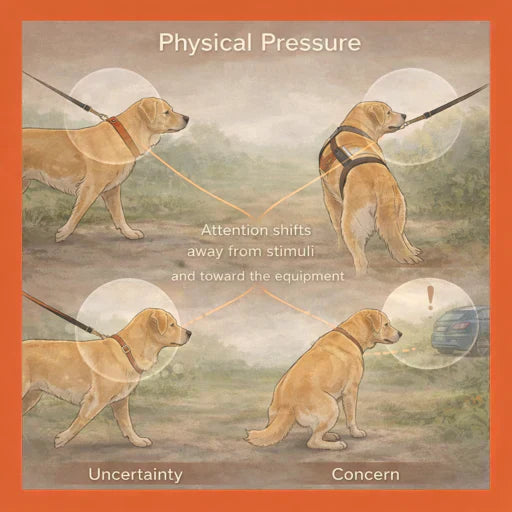
Physical pressure from a lead begins when tension travels through the line into the dog’s body. Once the lead tightens, it can affect posture, balance, movement, and behaviour.
When a lead tightens, physical pressure travels through the line into the dog’s body. That pressure changes posture, movement, and behaviour; it is not a neutral connection. The dog is no longer responding only to the environment. The dog is also responding to force coming through the body, and those two things interact from the moment tension appears.
This matters because a lead does not just follow behaviour. It can become part of the behaviour.
Once tension appears, the walk is no longer only about where the dog wants to go. It is also about how the dog’s body responds to pressure through the line.
A lead does not only connect the dog to the handler.
It can also transfer pressure into the walk.
What physical pressure a lead creates
A lead creates physical pressure when tension travels through the line into the dog’s body. That pressure may be felt at different points depending on the tool, the fit, the dog’s position, and the direction of movement.
So the lead is not only attaching the dog to the handler. It is also transferring force.
That force can affect posture, balance, rhythm, and freedom of movement. Even when the pressure looks mild from the outside, it may still be shaping how the dog moves through the walk.
Why that pressure changes behaviour
Lead tension changes behaviour because movement under restraint is not the same as movement in freedom.
Once the lead tightens, the dog is no longer responding only to the environment. The dog is now responding to the environment while also adjusting to pressure through the body. That can change speed, body position, effort, focus, and the way the dog reacts in the moment.
This is why tension is not neutral. It changes the conditions of behaviour.
Why dogs do not all respond the same way
Not all dogs respond to lead tension in the same way.
Some lean into it. Some brace against it. Some become more frustrated, more aroused, or more fixed on what they were trying to reach. Others may hesitate, slow down, freeze, or lose fluency in movement. What is arousal in dogs during walks explains how that internal activation state shapes the way each dog responds to the same physical pressure differently.
So pressure does not create one universal response. But it does reliably change the behavioural picture.
Why tension often escalates behaviour
Lead tension often escalates behaviour because it adds opposition to forward intent.
If the dog is already drawn toward something, restraint can intensify the moment rather than settle it. Frustration may rise. Arousal may rise. The body may push harder against the line. What began as forward interest can become stronger pulling, bracing, or conflict.
This is one reason tension often becomes self-reinforcing. The dog moves toward something, tension appears, behaviour changes, and the walk becomes more strained, and why tension increases pulling explains how that cycle keeps the pulling pattern alive rather than resolving it.
Why repeated tension becomes part of learning
Dogs do not only react to tension in the moment. They can also learn from repeated patterns around it.
If the same sequence happens often — stimulus, movement, tension, escalation — the dog may begin anticipating that pattern. Behaviour may then change earlier and faster, sometimes before the lead is even fully tight.
So lead tension is not only a physical event. Over time, it can become part of the dog’s learned walking experience.
The body remembers patterns and how pressure changes learning during walks explains how those repeated sequences shape what the dog expects and how movement is organised on future walks.
Why this matters
Understanding physical lead pressure changes how behaviour is interpreted.
Instead of seeing pulling only as disobedience or excitement, it becomes easier to see that the lead itself may now be shaping the response. The behaviour is not only about what the dog wants. It is also about what restraint does to the dog while wanting it.
That distinction matters because it changes what the walk is really organised around.
What the S-K9 ChestCollar changes
The S-K9 ChestCollar changes this picture by not relying on tightening, redirection, or stronger opposition as the main way to influence the walk. Instead of building the interaction around sustained restraint, it changes where contact appears and helps avoid the same kind of physical pressure pattern that can make movement heavier and behaviour more strained. Chest touch as a predictive cue in dog walking explains how that earlier timing creates a different physical experience from the start.That does not remove all pressure from walking, but it changes how much added pressure comes from the tool itself.
The S-K9 ChestCollar changes how much added pressure comes from the tool itself. You can see how the S-K9 ChestCollar is designed to do that.
What this page is not about
This page explains what physical pressure a lead creates and why lead tension changes behaviour during walks.
It does not fully explain:
-
the wider role of pressure across the whole walk. More on the Pressure Hub
-
how contact functions through the walk. More on the Contact Hub
-
how different tools work mechanically and structurally. More on the Tool Mechanics Hub
Key takeaway
A lead creates physical pressure the moment tension travels through the line into the dog's body. That pressure isn't neutral , it changes posture, movement, arousal, and behaviour in ways that vary by dog but are never absent.
Once restraint appears, the dog is no longer only responding to the world ahead. The dog is also responding to force , and that force becomes part of the walk whether the handler intends it to or not.
This article is part of the Pressure Hub
FAQ
What physical pressure does a lead create?
When the lead tightens, force travels through the line into whatever part of the body the equipment is attached to. That force changes posture, movement, and behaviour , it's not just a passive connection.
Why does lead tension change dog behaviour?
Because movement under restraint is different from free movement. The dog is now managing both the environment ahead and force coming through the body at the same time, and those two things interact.
Does lead tension always reduce pulling?
No. For many dogs, tension adds opposition to a drive that's still active , which can increase frustration, effort, and pushing into the line rather than reducing it.
Can dogs learn patterns around tension?
Yes. If tension appears repeatedly in similar situations, dogs begin anticipating it , organising their body earlier, bracing sooner, and sometimes pulling harder before the trigger has even fully arrived.
Is lead tension only a physical issue?
No. It starts as a physical event but becomes an emotional and learned one too. Repeated tension shapes what the dog expects from the walk and how the body prepares for it.