
Quick summary
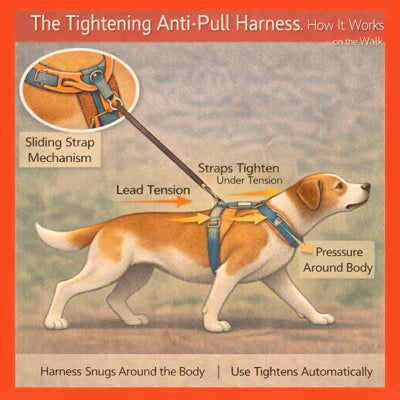
A tightening anti-pull harness works by becoming more snug around parts of the dog’s body when the lead becomes tense, so the fit changes as forward tension increases.
TL;DR
A tightening anti-pull harness sits on the dog’s chest and torso like a harness, but part of its structure tightens under load. When the dog moves forward and the lead becomes tight, sections of the harness become narrower around the body. Its main mechanical effect is body tightening under tension.
How a tightening anti-pull harness works
A tightening anti-pull harness is designed to sit around the dog’s chest and torso, but unlike a fixed harness, its fit changes when lead tension increases.
When the lead is loose, the harness usually sits in a more relaxed position on the body. But when the dog moves forward and the lead becomes tight, the design causes certain sections of the harness to pull narrower. Depending on the model, this can happen around the chest, torso, or areas near the front legs.
This means a tightening anti-pull harness works through body tightening under load.
Unlike a flat collar, it does not act through the neck. Unlike a standard back-clip harness, it does not simply hold the same shape while distributing force across the body. Its main mechanical feature is that the harness changes fit when the lead becomes active.
During movement, the more forward tension the dog creates, the more the harness engages within its design range. When the tension reduces, the harness may return toward a looser resting state. This creates a dynamic system rather than a fixed frame.
This is why a tightening anti-pull harness is often described as a harness that responds to pulling by becoming more snug. Its structure changes not only where the force is received, but also how the harness sits on the dog while the lead is under load.
The exact effect depends on the harness design, strap path, fit, and attachment point. But mechanically, the principle remains the same:
a tightening anti-pull harness changes the walk by making parts of the body frame narrower when lead tension increases.
Key takeaways
-
A tightening anti-pull harness sits on the chest and torso.
-
Its fit changes when the lead becomes tense.
-
Its main mechanical effect is body tightening under load.
FAQ
Does a tightening anti-pull harness stay the same size during a walk?
No. When the lead tightens, parts of the harness become more snug around the body.
Where does a tightening anti-pull harness act on the dog?
A tightening anti-pull harness acts through the body, usually around the chest and torso where the harness frame sits.
What happens when the lead becomes tight on a tightening anti-pull harness?
When the lead becomes tight, sections of the harness pull narrower and the fit changes around parts of the body.
Internal link anchor
Learn more: Explore the full guide to traditional dog walking tools and their mechanics.
Continue exploring:
[Dog Walking Tools Compared: Risk, Comfort, and Training Knowledge]
[The Contact HUB: How the S-K9 ChestCollar Changes the Walk]