
Quick summary
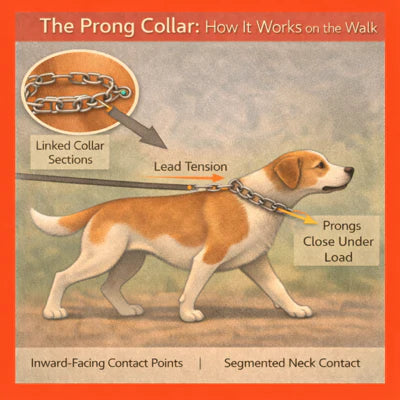
A prong collar works by tightening slightly around the dog’s neck when the lead becomes tense, creating contact through multiple inward-facing links placed around the collar.
TL;DR
A prong collar is made of linked metal segments with inward-facing prongs arranged around the neck. When the lead tightens, the collar narrows and the links press inward at multiple points. Its main mechanical effect is segmented neck contact under tension.
How a prong collar works
A prong collar is built from a series of metal links connected together to form a collar around the dog’s neck. Each link includes an inward-facing prong, so the collar creates multiple contact points around the neck rather than one continuous flat surface.
When the lead is loose, the collar sits around the neck in a more relaxed state. But when the dog moves forward and the lead becomes tight, the collar narrows slightly. As it does, the inward-facing links press more firmly into the neck.
This means a prong collar works through segmented neck contact under tightening tension.
Unlike a flat collar, it does not simply transmit force through a single band around the neck. Unlike a choke chain, its contact comes through fixed linked sections rather than a smooth sliding loop alone. Its design changes how the force is distributed by creating multiple separate contact points around the collar.
During movement, the more tension placed on the lead, the more the collar engages. When tension reduces, the collar relaxes again. The mechanical effect therefore depends on the collar tightening and the linked segments pressing inward as force increases.
This is why a prong collar is often described as a collar that acts through multiple points around the neck instead of through one continuous strip of material. Its structure changes not only how the collar tightens, but also how contact is delivered when the lead becomes active.
The exact effect depends on fit, link size, collar position, and lead handling. But mechanically, the principle remains the same:
a prong collar changes the walk by tightening around the neck and creating contact through multiple linked points when lead tension increases.
Key takeaways
-
A prong collar is made from linked metal sections with inward-facing prongs.
-
It narrows when the lead becomes tense.
-
Its main mechanical effect is segmented neck contact under tension.
FAQ
Does a prong collar stay the same size during a walk?
No. When the lead tightens, the collar narrows slightly around the neck.
Where does a prong collar act on the dog?
A prong collar acts around the neck, because that is where the linked collar sits and where the contact points engage.
What happens when the lead becomes tight on a prong collar?
When the lead becomes tight, the collar contracts and the inward-facing links press more firmly into the neck from multiple points around the collar.
Internal link anchor
Learn more: Explore the full guide to traditional dog walking tools and their mechanics.
Continue exploring:
[Dog Walking Tools Compared: Risk, Comfort, and Training Knowledge]
[The Contact HUB: How the S-K9 ChestCollar Changes the Walk]