
Quick summary
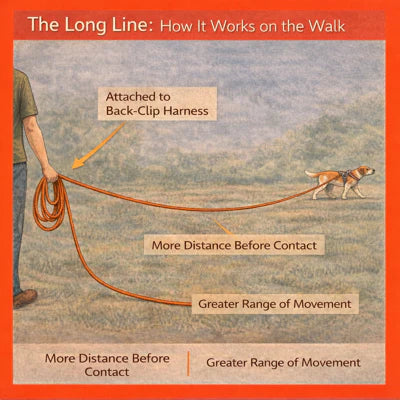
A long line works by increasing the distance between dog and handler, so lead contact happens later and movement can build over a greater range before tension appears.
TL;DR
A long line is a longer lead that gives the dog more space before the line becomes tight. When tension finally appears, the timing and momentum of that contact can be different from a short lead. Its main mechanical effect is delayed contact over a greater distance.
How a long line works
A long line is not a different collar or harness by itself. It is a longer lead that can be attached to different walking tools, but its extra length changes the mechanics of the walk.
When the line is loose, the dog has more space to move before reaching the end of it. This means lead contact does not happen as early as it would on a shorter lead. The distance between dog and handler becomes part of the mechanical system.
This means a long line works through greater range and delayed contact.
Unlike a short lead, it does not create early feedback from a nearby connection point. Instead, it allows movement to continue over more distance before tension appears. If the dog slows, stops, changes direction, or accelerates, those changes happen across a longer line before the full effect reaches the handler.
During movement, this increased range also changes momentum. A dog may gather more speed before the line becomes tight, and when contact finally happens, the effect can feel different because force has developed over more space. The longer line also changes timing, because contact arrives later than it would on a shorter lead.
This is why a long line is often described as changing freedom of movement rather than changing the dog’s attachment point. Its mechanical effect comes from length, timing, distance, and momentum, not from a different collar or harness structure.
The exact effect depends on line length, material, handling, speed, terrain, and the tool it is attached to. But mechanically, the principle remains the same:
a long line changes the walk by delaying lead contact and increasing the distance over which movement can develop.
Key takeaways
-
A long line gives the dog more distance before tension appears.
-
It changes the timing of lead contact.
-
Its main mechanical effect is delayed contact over a greater range.
FAQ
Does a long line change where the tool acts on the dog?
No. The attachment point stays the same, but the longer line changes when and how lead contact happens.
What happens when a dog reaches the end of a long line?
When the dog reaches the end of a long line, contact happens later than on a short lead and may involve more built-up movement or momentum.
Is a long line a different walking tool by itself?
No. A long line is a longer lead, not a separate collar or harness, but it changes the mechanics of the walk through distance and timing.
Internal link anchor
Learn more: Explore the full guide to traditional dog walking tools and their mechanics.
Continue exploring:
[Dog Walking Tools Compared: Risk, Comfort, and Training Knowledge]
[The Contact HUB: How the S-K9 ChestCollar Changes the Walk]