
Quick summary
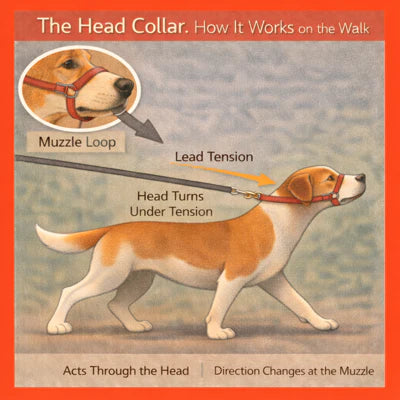
A head collar works by placing the lead attachment on the dog’s head, so when the lead becomes tight, the direction of the head changes before the rest of the body follows.
TL;DR
A head collar fits around the muzzle and behind the head, with the lead usually attaching under the chin. When the dog moves forward and the lead becomes tight, the tool influences head position first. Its main mechanical effect is head-based directional control.
How a head collar works
A head collar is designed to sit around the dog’s muzzle and behind the head. In most designs, the lead attaches below the muzzle or under the chin, which changes where lead tension first enters the dog’s movement.
When the lead is loose, the head collar sits passively on the head. But when the dog moves forward and the lead becomes tight, the point of attachment begins to affect head direction. Because the head leads the body, changing head position can also change the dog’s line of movement.
This means a head collar works through head-based directional control.
Unlike a flat collar, it does not mainly act around the neck. Unlike a harness, it does not primarily distribute force through the chest and torso. Its main mechanical feature is that the lead acts on the head first.
During movement, the dog’s head may be guided slightly to the side or downward depending on the tool design, lead angle, and handler position. As head direction changes, the rest of the body tends to follow.
This is why a head collar is often described as a tool that changes direction through the head rather than through the body. Its structure alters movement by making the head the first point of lead influence.
The exact effect depends on fit, muzzle loop design, lead angle, and how the dog moves into tension. But mechanically, the principle remains the same:
a head collar changes the walk by making head position the first point of directional change when lead tension increases.
Key takeaways
-
A head collar fits around the muzzle and behind the head.
-
It makes the head the first point of lead influence.
-
Its main mechanical effect is directional control through head movement.
FAQ
Does a head collar work through the neck?
No. Its main point of action is the head, especially the muzzle and head position, rather than the neck alone.
What happens when a dog pulls in a head collar?
When the dog moves forward into tension, the head can be guided sideways or downward depending on the lead angle and tool design.
Is a head collar designed to change direction?
Yes. Mechanically, its main effect is to influence the direction of movement by acting on the head first.
Internal link anchor
Learn more: Explore the full guide to traditional dog walking tools and their mechanics.
Continue exploring:
[Dog Walking Tools Compared: Risk, Comfort, and Training Knowledge]
[The Contact HUB: How the S-K9 ChestCollar Changes the Walk]