
What physical pressure does a lead create for a dog?
Quick summary
A lead doesn’t just connect dog and handler — it introduces physical pressure the moment movement meets resistance.
The instant a lead is clipped on, a dog’s movement no longer exists in isolation.
What would normally feel like “I’m moving toward something” can quickly become “something is tightening, holding, or pulling me back.”
This is the birth of physical pressure.
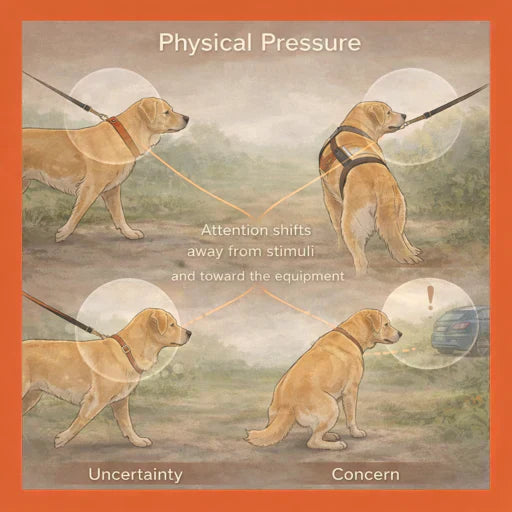
Physical pressure appears when movement meets resistance. On a lead, that resistance can come from tension, restriction, redirection, or even subtle tightening long before a full pull happens. The dog’s body is no longer responding only to the environment — it is also responding to the sensation created by the tool.
That shift matters.
Once resistance is felt, attention often moves away from the original trigger and toward the body itself. Instead of processing what drew them forward — a sound, a smell, another dog — the nervous system starts processing the pressure.
This changes the learning landscape entirely.
Environmental pressure invites adjustment and resolution. Physical pressure introduces friction. The dog is now negotiating two inputs at once: the world ahead and the sensation acting on their body. For many dogs, this added layer disrupts natural regulation rather than supporting it.
Importantly, this happens before any training, correction, or intention. The change is mechanical, not behavioural. Even calm, well-adjusted dogs experience this shift the moment resistance appears.
Understanding physical pressure clarifies why leads so often escalate situations rather than settle them. It isn’t about obedience or attitude — it’s about what the body feels when free movement is interrupted.
Learning doesn’t stop, but it changes direction. Instead of learning from the environment, the dog begins learning about pressure.
Key Takeaways
- Physical pressure starts when movement meets resistance
- Leads introduce a second stimulus: the tool itself
- Attention shifts from environment to bodily sensation
- This shift alters how learning unfolds
FAQs
Does all leash use create physical pressure?
Pressure appears the moment tension or resistance is felt, even briefly.
Is physical pressure always harmful?
Not inherently — but it changes the learning context immediately.
Why do some dogs react strongly to leads?
Because their regulation shifts from environmental processing to bodily sensation.