
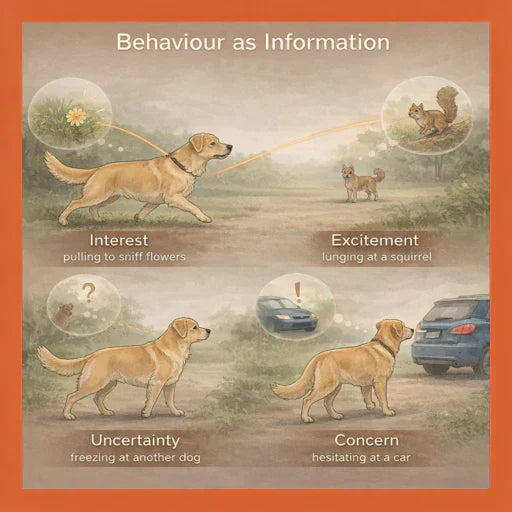
Is pulling on the lead a sign of disobedience or something else?
Quick summary
Pulling on the lead is not bad behaviour — it is information expressed through movement.
Pulling is often misunderstood as defiance, stubbornness, or a failure of training.
In reality, pulling is rarely a choice to disobey.
When a dog pulls, lunges, freezes, or hesitates, what you are seeing is the first physical expression of how they are processing the world. Interest, curiosity, excitement, uncertainty, or concern all appear first through the body — long before conscious regulation has time to intervene.
Movement comes before meaning.
A dog does not pause to decide whether to be compliant. Their nervous system responds to incoming environmental information, and the body moves. That movement is not a problem to be fixed; it is data.
This is why pulling is so often mislabelled as “bad behaviour.” Humans tend to interpret movement through a moral or obedience-based lens: won’t listen, being difficult, needs more training. But from the dog’s perspective, nothing has gone wrong. The body has simply reacted faster than reflection.
Seen this way, behaviour stops being something to suppress and becomes something to observe.
When movement is immediately corrected, redirected, or overridden, its meaning is cut short. The dog loses the opportunity to feel the full loop — stimulus, movement, resolution. Learning stalls because the signal never completes.
When movement is allowed to finish expressing what it carries, regulation can follow. The dog can settle, adjust, or disengage on their own terms.
This shift — from judging behaviour to reading it — changes everything. Pulling is not disobedience. It is communication happening in the only language the nervous system speaks first: motion.
Key Takeaways
- Pulling is not defiance or disobedience
- Behaviour is the body’s first response to information
- Movement happens before conscious regulation
- Learning starts when behaviour is observed, not interrupted
FAQs
Is pulling ever intentional disobedience?
Rarely. Most pulling occurs before deliberate choice is possible.
Should behaviour still be corrected?
Correction stops information mid-process. Observation allows learning to emerge.
Why does re-framing behaviour matter?
Because what we label as “bad” often holds the clearest insight into a dog’s state.